
“Analysis paralysis,” is a favorite phrase of a friend of mine. I understand why. In addition to its pleasant bobbing rhythm and rhyme, it straightforwardly conveys the problem it seeks to describe.
With good intent, a person begins to thoughtfully consider an event, idea, or phenomenon they’ve encountered—presumably with the goal of exercising good judgement and coming to a prudent decision. Tragically, and sometimes comically, the process of being reasonable turns into a game of discovering every rationally defensible approach or conclusion.
Rationality is a good thing. However, when worshipped on its own in an amoral mind and culture, cold hard reason can send a person spiraling through a world of endless possibility—endless choice. Immersed in this limitless world, the person discovers that, despite his best efforts, he is further from a clear conclusion than he was when he set the wheels of his brain in motion. Much like The Thinker, the analyzer is frozen in his activity, without hope of release.
Many popular films nowadays seem to present stories about mostly amoral characters trying their best to break this paralyzing cycle and act, despite lacking a definitive moral compass to guide their decision-making process. Strangely, this introspection can increasingly be found in a film genre typically ruled by clear black and white, hero vs. villain themes or tropes. This is the action/adventure/thriller genre. Although hints of traditional morality may exist, the conflict of good and evil seems largely replaced by a conflict of competing interests. Who you support depends on the eyes through which the narrative is presented.
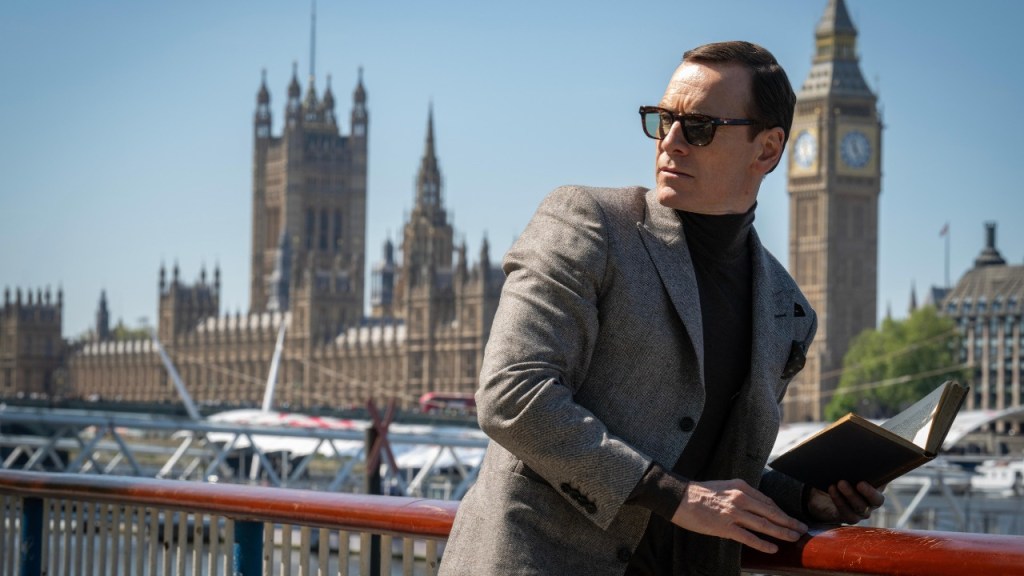
The spy thriller Black Bag is such a movie. Instead of a typical globetrotting, “destroy the evil totalitarian enemy of democracy and the free world” plot, it focuses on the in-office struggle of seven (arguably six) key figures in the United Kingdom’s National Cyber Security Centre (NCSC) following the leak of sensitive data and news of a mole in the agency.
With the exception of a brief scene in Zurich—much of which is observed through live security footage in England—the film mainly focuses on three domestic locations: the Woodhouse home, the NCSC office building, and a small rural spot on a fishing pond where George Woodhouse retreats for privacy. Limiting the physical scope of the film serves as a general invitation to focus your attention and energy on the characters’ internal lives, desires, motivations, and boundaries.
A straightforward invitation to assess the characters in terms of morality, responsibility, and guilt occurs in the first twenty-or-so minutes of the movie. During this time, George Woodhouse invites those he initially suspects of criminal behavior to a dinner party, where he uses some sort of truth serum cooked into the food to loosen his guests’ tongues. He then proposes that the party play a game, where each person makes a resolution for the person on their left.
Although each character seems to have distinct personal problems—one is addicted to pills, alcohol, and sex; another is clearly arrogant in his success; George himself is possibly OCD—there’s a general sense of a world-weary, cynical sickness that seeps through all of them. In short, all the characters have baggage, and the director or script-writer wants the audience to know that this baggage is affecting their decisions.
To briefly illustrate this point, consider the character Clarissa Dubose, a young member of NCSC, who is invited to the dinner party. Within 10 seconds of meeting her we learn that her parents are divorced and hate each other. At the dinner party, in the context of a conversation about past government operations that claimed many lives, she blurts out “Most of us are sick as sh**.” She speaks like most brain-dead people her age who don’t have the imagination to develop her vocabulary. Another example is the “Catholic” therapist Dr. Zoe Vaughan who has had two sex partners in the span of a few months and is revealed to have a penchant for erotic fiction. Despite her claim that she “does not find amorality attractive” she prefers to call people complex rather than judge them for their actions.
Many of the other characters are the same. They recognize that they have “issues” and they seem to feel guilt in some way, but they lack the spiritual foundation to admit that what they are doing is bad for their souls and to look for something healthier for their humanity. The only moral code or bond that survives in the film is the Woodhouse marriage. They stick together through thick and thin because of some sort of transcendent ability to commit.
I would not have my reader think that this movie is good simply because it is introspective. In many ways, the movie was slow and the plot struggled to survive in the setting it had been given. However, what an artist produces can often teach us about their mind and the world that formed them. If his art is bad, it still may be useful to look at it to figure out what went wrong with him to begin with.
I would recommend watching this film if only as an opportunity to think about what passes for story-telling and what themes artists seem to be struggling with in their minds.


 Perligo
Leave a comment