
Not too long ago, I had the privilege of visiting the St. Frances Cabrini Shrine in Washington Heights, New York City. Mother Cabrini’s body lies in full habit in a glass coffin inside the main altar of the church.
Attached to Mother Cabrini’s shrine is a small museum documenting her life, work, and disposition towards her vocation. The language was clear. Her life of service relied not on her strength but God’s. Her physical weakness—chronic lung issues starting at a young age—is what makes her work that much more miraculous.
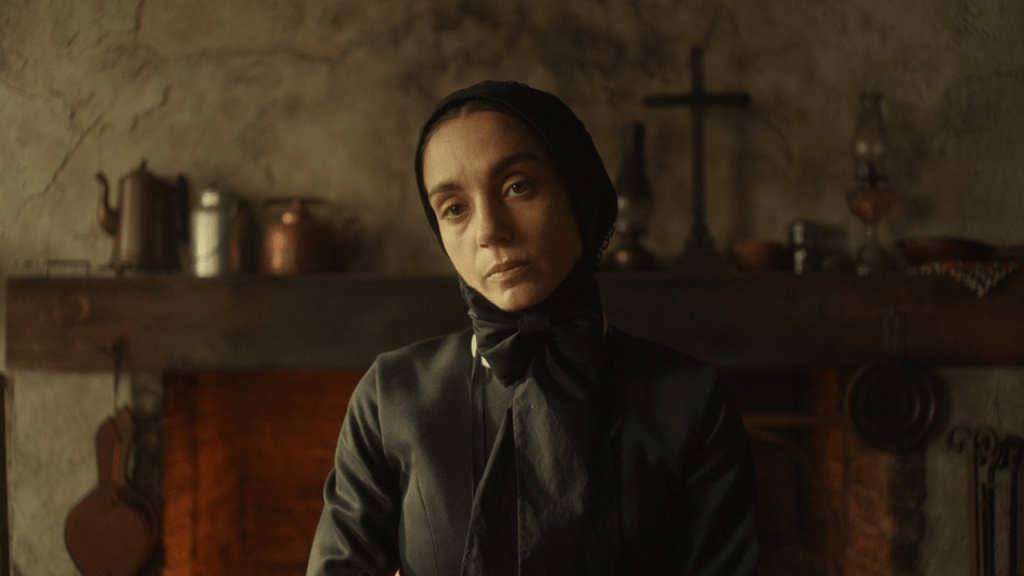
Shortly after this visit, someone suggested I watch the 2024 film Cabrini.
What a deplorable contrast.
For those who think I may be on the verge of nitpicking, and that film directors must be given allowances to produce works that are palatable to a wider movie audience, I offer the following quote attributed to the real Mother Cabrini:
“A single act of humility is worth more than the proud exhibition of any virtue.”
The Cabrini of the 2024 film would never have uttered those words. Her message follows more along the lines of “women can do anything; sometimes, we need God’s help.” This mistake in depicting Mother Cabrini’s character could possibly be overlooked if she appeared as a side character in a movie about some other major contemporary church figure or historical event related to her work, like Leo XIII or the orphan problem in 19th-century NYC. But that wasn’t the movie the film directors intended to make. The film directors set out to make a biographical film entirely about the life story of Mother Cabrini and then got the personality of the title character wrong. That’s bad storytelling and sloppy research.
Movie audiences don’t deserve to be lied to, and film directors do not fulfill their obligations as artists when they shy away from narratives that aren’t necessarily socially acceptable.
Now that you know I think this movie was a train wreck, I’ll dive into its mess.
The film opens with a depiction of Mother Cabrini and her fellow nuns hard at work in their rural Italian residence. Cabrini receives a letter calling her to the Vatican for a meeting.
Enter the pretentious patriarchy!
At the Vatican, Cabrini is told by a patronizing cardinal that she is not to leave for China—the place to which her missionary zeal most inspires her to travel—and that Pope Leo XIII wants her to do nothing but attend to orphans in her location in Italy. This demand to serve impoverished children in Cabrini’s local community is somehow supposed to appear unreasonable.
According to the movie, Pope Leo would have ignored Cabrini’s request completely had her heroic feminist agita not inspired her to insist on a direct audience with him.
Pope Leo agrees to see her, reiterates the first cardinal’s words, and moves on. Cabrini yells at him some more and in a stereotypical “No woman has spoken to me—a man—like that before, and now I’m impressed” moment, Pope Leo dramatically cancels all his other appointments and has tea with Cabrini. It is in this meeting that Leo gives her the command, “Not to the east, but to the west.”
What follows is a truly inspirational series of events that is yet again set in a context that is antithetical to the life of virtue and sanctification as it would be approached by a saint in the Catholic Church. Before setting off for New York City, where she is told to assume charge of an orphanage in the infamous Five Points neighborhood, Mother Cabrini prepares her fellow sisters by warning them: “Without men, we will be expected to fail. More than ever, we must trust in ourselves. And in the purpose of our mission.”
Set aside, for a moment, the fact that distrust of self—i.e., presumptuousness in personal strength and knowledge—and firm confidence in God are key in building a basic foundation for one’s spiritual life (and that Mother Cabrini probably understood this better than anyone given her chronic illness). Such a statement and the attitude it introduces is incredibly insulting to all the female saints of the Church.
A close friend of mine who obtained her M.A. from Columbia in literature in the 1980s once told me about a class she took on writing biographies. “The only reason St. Thérèse of Lisieux became a mystic,” her teacher had stated in class “is because that was the only way she could get the Church to accept her as an intellectual woman.”
By portraying Mother Cabrini as a defiant feminist struggling with the patronizing clergy, the filmmakers undermine her relationship with the Church in much the same way that this Columbia professor undermined St. Thérèse of Lisieux’s identity. More than that, both perspectives undermine the entire rich tradition of female saints in the Church by suggesting that, to be an intelligent saintly female requires conflict with an inherently patriarchal Church structure. This implication is based on a basic secular, liberal premise that to be a liberated woman one must live up to modern feminist standards.
Cabrini was fun to watch. There was good storytelling employed at times, and at times, I was genuinely inspired to learn more about Mother Cabrini. But the entire film is peppered with feminist, entrepreneurial platitudes similar to the ones I’ve quoted. The blatant inability of the film-makers to understand Cabrini’s life on Catholic terms—that is, from the actual perspective of the movie’s title character—is so frustratingly indicative of a lack of intellectual depth and a good faith attempt to tell a true story that the movie as a whole is further evidence that modern society no longer knows how to think and write in keeping within a western tradition of thought, even when talking about an historic 19th century, European figure.
Given that a basic tenet of a liberal progressive approach to storytelling is to understand people within the perspective of their intellectual values and cultural norms, Cabrini doesn’t even live up to its own standards.


 Perligo
Leave a comment