
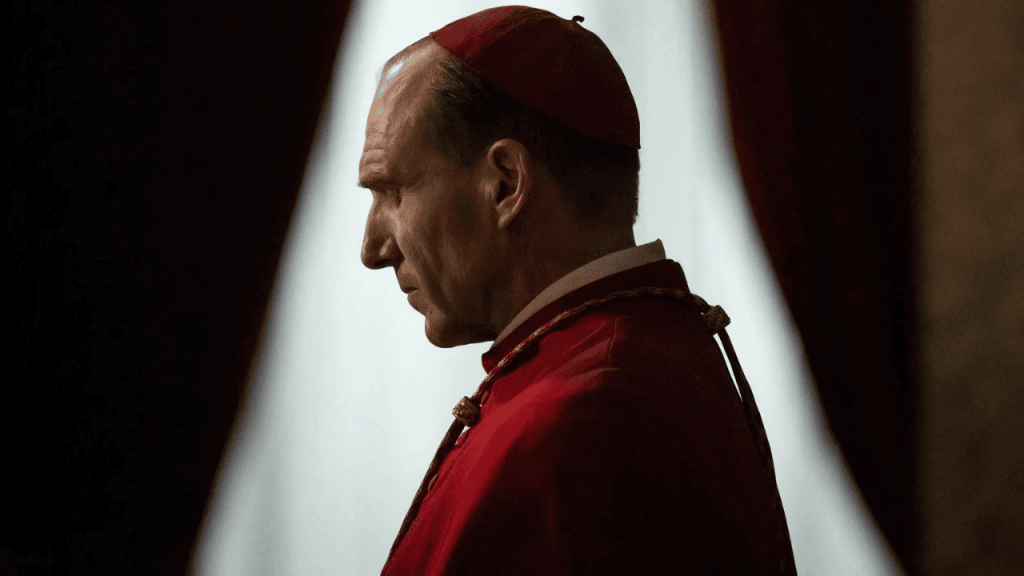
Since the recent papal election, it has been popular on social media to toss around this quote attributed to Pope Leo XIII:
“The worst kind of heretic is one who, teaching for the most part true Catholic doctrine, adds a word of heresy like a drop of poison in a glass of water.”
There’s a fundamental axiom at work here—i.e., that it is desirable to maintain to the highest degree possible the purity of truth to avoid leading people into error.
In contrast, the saying, “learn to take the good with the bad” suggests that it is rare, in daily life, to come by pure truth; so, you must distill whatever you get, wherever you can get it.
Imagine a valley of truth bounded by the limits suggested by these phrases. The movie Conclave dances perilously around the edges of this valley, tempting its audience through its dishonest proximity to the truth to believe in its intellectual and creative depth.
From a technical standpoint it is, unfortunately, a well-made and enjoyable film. It is paced well and full of aesthetically appealing shots of liturgical symmetry and order: the beauty of St. Peter’s Basilica, the Sistine Chapel, and the general Vatican grounds. Some of these beautiful shots—especially those depicting interactions among clergy and religious life in the context of administrative and liturgical duties—indicate that the film-makers have a completely disconnected, archaic view of the Church that conveys a sort of liberal nostalgia. (More on that later.)
I say unfortunately because the impressive technical or “accidental” aspects of the film may serve to delude the vast majority of viewers (who probably know nothing about the state of the Catholic Church) into thinking that the substance of the movie is somehow truthful and good.
I hope this clarifies what I mean by the film ‘dancing perilously’ around a valley of truth. The film-makers and actors clearly poured a great deal of creative energy into the movie to distract from the fact that it is full of straw men. The egos of several famous actors also serve to prop up the film’s trite tropes.
Before diving into plot summary, I will state my thesis in clear terms. To some, my perspective may appear exaggerated—attributing malice intent where one could assume basic human arrogance and ignorance. So, I will conclude this review by putting the popularity of the movie in the context of the recent conclave and certain events that surrounded it.
The movie Conclave is, whether intentionally or unintentionally, an artistically-constructed piece of liberal DEI propaganda disguised as an accurate representation of modern issues in the Catholic Church. The movie’s script, characters, and plot reveal that its directors understand embarrassingly little about Catholicism and the Church.
The film has the task of making liberal progressives in the Church appear sympathetically moderate. The only way this can be accomplished is if liberal progressive clerics are depicted as a minority faction victimized by more powerful forces—in this case, traditionally-minded curia and power-hungry cardinals.
It is for this reason that I suggested the whole film is imbued with liberal nostalgia. All the characters and activities are depicted as if the Church is still in the process of shaking off the yoke of outdated, repressive, conservative, traditional Catholic values. In other words, if one wants to understand modern political Church dynamics, simply reverse everything the film says, shows, or does.
Now for some plot points:
The film begins with the death of a Pope Francis-like character. He is depicted as being a liberal, progressive, very intellectual man, well-loved by other “moderate” liberal progressive clerics in the Vatican and despised by the power-hungry, traditionally-minded curia.
Fast forward three weeks to the eve of the conclave. The movie’s protagonist, Cardinal Lawrence—Dean of the College of Cardinals and friend of the late pope—is preparing the Vatican and the Sistine Chapel for the sequestering of the cardinals and the election.
A number of issues arise very early on. First, a new Mexican cardinal serving a diocese in the Middle East arrives on the scene. He claims to have been made a cardinal by the late pope “In Pectore,” meaning that his appointment was not officially documented. After a brief deliberation, the new Cardinal Benitez is invited to participate in the election. Benitez immediately makes an impression on his brother cardinals by saying grace at dinner in English, then Spanish, thanking the Nuns who made the food, and mentioning those who cannot eat, drink, or do not have a place to stay.
How beautiful! A DEI-hire cardinal using the name of Christ and saying something Catholic. How unheard of for an institution that has somehow spanned the entire known world for centuries.
The second issue arises when Archbishop Wozniak—a close friend of the late pope who was present at his last few meetings and his death—reveals to Dean Lawrence that the pope fired Cardinal Tremblay, a major contender for the papacy, in his last meeting with him. Lawrence confronts Tremblay, who denies the accusation. Nevertheless, Cardinal Lawrence sends a priest named O’Byrne to corroborate Tremblay’s denial with a third party. This third party’s emphatic denial that Tremblay was fired arouses more suspicion than it alleviates.
While these issues are developing, certain key figures are introduced, including the racist, fiery-tempered, Italian, conservative traditionalist Cardinal Goffredo Tedesco. In Conclave, the Italian cardinals are the conservative traditionalists. Practice the reversal I suggested earlier and you have the modern reality.
At the Cardinals’ first dinner, Tedesco invites Dean Lawrence to sit with him. Lawrence comments on all the different races present in the room, which he believes indicates the beautiful diversity and unity of the Church. Tedesco jeeringly points out that all the different races sit separately as they are divided by language.
Here I would like to insert that the newly-elected Pope Leo XIV speaks English, Spanish, Italian, French, and Portuguese, and that he is not an anomaly.
Tedesco continues to explain that when Latin was the language of the Church, the cardinals wouldn’t have had this problem.
Lawrence teases Tedesco for wanting to elect a conservative, traditionally-minded, Italian pope. Tedesco responds, “Why not. Can you imagine the alternative,” then points to the African Cardinal, Adeyemi. The irony is that the African Cardinals, as the movie itself later emphasizes, are similarly traditionally-minded and conservative.
In a later scene, the liberal progressive cardinals—to use the terms expressed in the film—meet together to discuss a possible candidate for election. It becomes clear that Cardinal Bellini, a dear friend of the late pope, is a favorite among the liberals. It is at this time that Bellini states:
“Tell them I stand for a common sense approach to such issues as gays and divorce. Tell them I stand for never returning to the days of the Latin liturgy; or families of ten children because mama and papa didn’t know any better. That was an ugly and repressive time, and I’m glad that it’s over. Tell them I stand for respecting other faiths; for tolerating other views—within our own Church; and tell them that I believe women should play more of a role in the curia.”
I’m not sure what “a common sense approach” means. But something about the rest of Bellini’s statements suggests that it doesn’t have anything to do with Catholic doctrine.
On the first day of the conclave, Dean Lawrence delivers a homily, which he had previously written down. In a trope-to-end-all-tropes moment, Dean Lawrence puts down his homily and begins in English, “Let me speak from the heart for a moment.”
Enter a confusing, damaging monologue that flits around glimpses of the truth while remaining thoroughly flawed.
“St. Paul said be subject to one another out of reverence for Christ. To work together, to grow together, we must be tolerant. No one person or faction seeking to dominate another. Speaking to the Ephesians who were of course a mixture of Jews and Gentiles, Paul reminds us that God’s gift to the Church is its variety. It is this variety, this diversity of people and views, which gives our Church its strength. Over the course of many years of service to our Mother the Church, let me tell you, there is one sin which I have come to fear above all others. Certainty. Certainty is the great enemy of unity. Certainty is the deadly enemy of tolerance. Even Christ was uncertain toward the end. ‘My God, my God, why have you forsaken me?’ Our Faith is a living thing precisely because it walks hand in hand with doubt. If there was only certainty and no doubt, there would be no mystery. And therefore no need for faith. Let us pray that God grants us a pope who doubts. Let him grant us a pope who sins, and asks for forgiveness, and carries on.”
The amount of literary surgical operation you have to do to rearrange and reinterpret these words so that they represent some semblance of the truth is truly astounding. That is, however, the problem with this homily and the movie as a whole. Both use certain key words and ideas that the Catholic Church cannot afford to be redefined for liberal ideological purposes. It is for this reason that I believe Conclave is an incredibly problematic film that cannot be ignored. It initiates a conversation from which Catholics cannot afford to back away. In this way, the homily is a sort of microcosm of the film.
Dean Lawrence’s words reduce Christ to a social justice warrior figure who comes to earth not to spread the truth but merely to tell all the peoples of the world that they never really needed him in the first place. Secular, pluralist, tolerance is established as the virtue of the Church. Christ’s purpose is not to clue everyone in on the good news but to say, ‘All of you have the truth in your own special way. You just need a bureaucratic DEI program to help you find it.’ It is of course true that part of what makes the Church beautiful is the fact that, in spite of extremely different cultural, intellectual, and historical heritages, all peoples can be united in the truth. This is, however, very different from saying that tolerance is at the core of the Church’s strength.
Faith, mystery, and wonder are all important things for a life of philosophical and theological inquiry. Certainty in one’s own knowledge and strength is highly problematic. Certainty, however, in the truth of the Faith and in God is a requirement. It may be healthy for someone to doubt so as to bring them to greater wonder and faith in the mystery of God and His Church. But for a cardinal to advertise doubt as a virtue promoted by the Church with regard to its doctrine is another matter.
The lines Dean Lawrence quotes come from a psalm that Christ references while hanging on the Cross. The psalm begins by acknowledging the suffering taking place but ends with a message of hope in deliverance. Christ’s words on the Cross are, therefore, not an expression of doubt but a momentary acknowledgement of both the suffering He is undergoing and the deliverance to come afterwards. This is reinforced by the fact that, leading up to His Passion and death, Christ frequently predicts his death and resurrection, meaning He knows His suffering is both temporary and highly purposeful. In short, Dean Lawrence is a bad reader of scripture.
The movie concludes with the election of Cardinal Benitez, the newcomer, who turns out to be intersex—i.e., displaying both female and male sex characteristics. Benitez says his condition was known and accepted by the pope, allowing Benitez to continue serving the Church as a priest and cardinal.
In the last moments of the film, Dean Lawrence asks Benitez, “What are you?” To which Benitez responds, “I am what God made me.”
No doubt, Benitez, despite his unfortunate situation, is still made in the image and likeness of God. However, if a child is tragically born without arms or legs—although we would never question that he is loved by God and that his life has dignity and unique beauty—we would still recognize his situation as being unnatural and a consequence of a fallen world. Conclave somehow tries to suggest that being intersex is a third, completely normal sexual state specifically intended by God.
This twist at the end is necessary for the resolution of an ongoing theme in the movie—namely, the conflict between the dark, male-dominated world of Church administration and the light, tolerant world of the feminine. In the film’s closing scene, Dean Lawrence opens up his stuffy room to let in the light. As he does so, three nuns cheerfully skip across the piazza in front of him, laughing and talking amongst themselves. The contrast is clearly meant to indicate that, with the election of a new pope, a balance is struck between the traditional patriarchy and the Church of the future, which has more of a place for women.
Mitchell and Webb are two British comedy-skit actors. In one of their skits, they play two down-on-their-luck tv-show actors who want to make a hit drama show about an emergency medical room. But they don’t want to do any research. They don’t want to understand any of the technical terms or get weighed down by the jargon. So they just portray their version of a medical drama without knowing anything about doctors or nursing.
The result is hilariously farcical. At one point a nurse brings a doctor a bottle with some generic label like ‘medicine.’ The doctor takes a look at it and screams, “You fool nurse, this is medicine for a different illness from this one.” He then rushes off to be busy and yell at more people.
Conclave would be similarly funny if it didn’t insist upon itself as deeply intellectual. It is insulting in its portrayal of key figures and in its depiction of the Church. The filmmakers clearly decided that their audience would be happier with gross stereotypes than with the challenge of encountering complex, opposing worldviews. It is a thoroughly stunted piece of drudgery whose narrative barely holds up when confronted with the truth.
A final note on propaganda. A recent article in CNN has called out Catholic journalists Diane Montagna and Edward Pentin for interfering with the papal election. Both Montagna and Pentin have worked on a website that compiles information about the cardinal electors for the sake of aiding the conclave in its decision-making process. The cardinals in this most recent conclave did not know much about one another and had limited time to acquaint themselves before being sequestered. Montagna and Pentin published this information in a pamphlet form and distributed copies to cardinals before they were sequestered. This, CNN claims, is blatant interference.
Meanwhile, it has been widely advertised that certain cardinals watched the movie Conclave on their way to Italy. Many major news sites claimed that the cardinals watched the movie for pointers on what was to come. Catholics compiling information on cardinals for the sake of other cardinals is not propaganda. Hollywood stereotyping traditional Catholics and suggesting the election of an intersex pope for the sake of bridging the gap between male and female is very much propaganda.
Not only that, but it is insulting to the lives of countless female saints whose contribution to the Church has been welcomed and has served as an inspiration to countless Catholics.



 Perligo
Leave a comment